How to Build a Public Product Roadmap (With Examples)

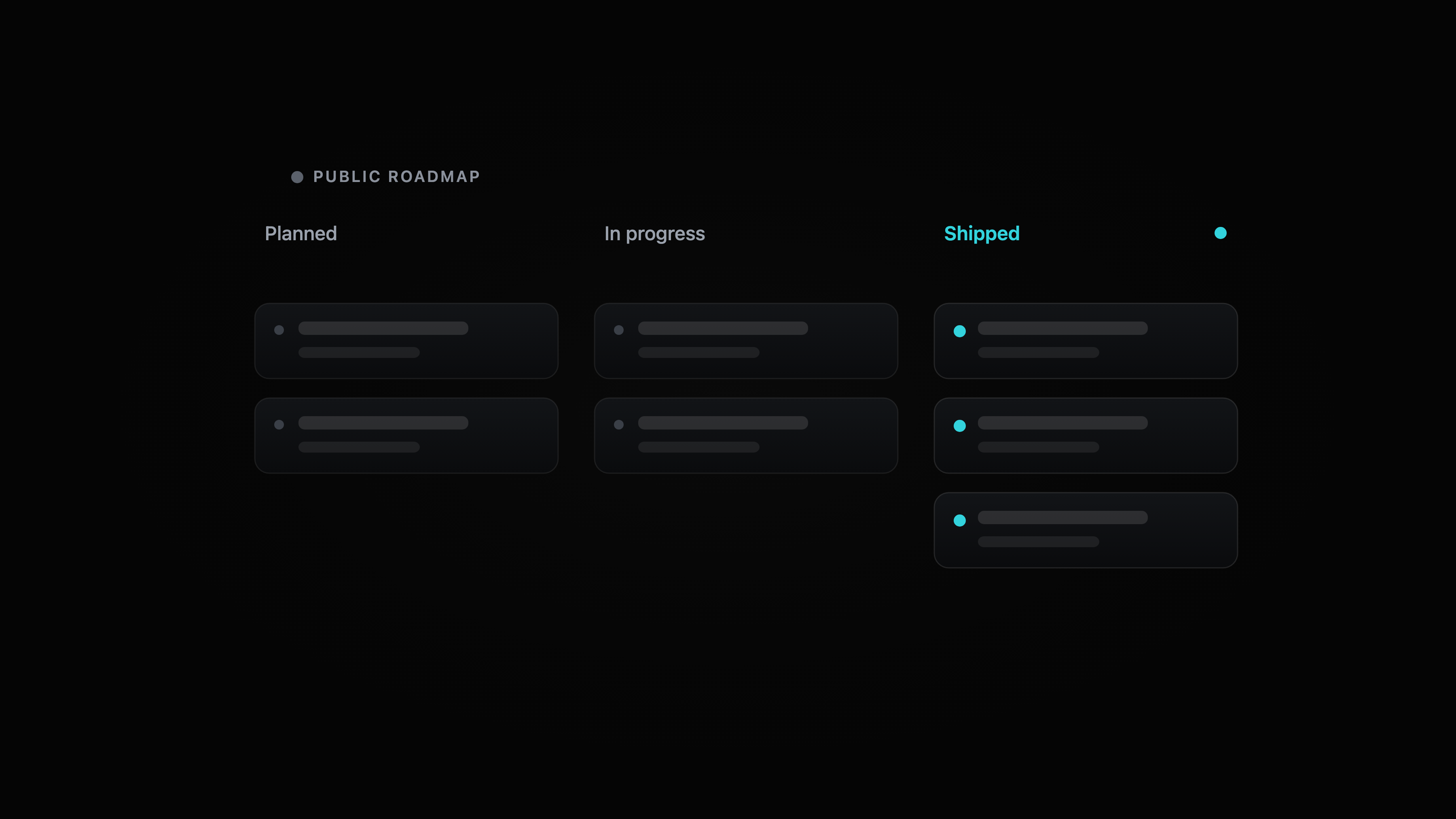
A public product roadmap is the part of your plan you choose to show customers: the themes you're working on, what's in progress, and what just shipped. Some teams publish one and watch their feedback get sharper overnight. Others publish one, miss a few self-imposed deadlines, and spend the next quarter explaining themselves. The difference is rarely the tool. It's what you decide to put on the board and how you maintain it.
This guide covers what a public product roadmap actually is, the upside and the real risks of going public, the column models that work, what to include and what to leave off, and how to keep the whole thing current so it earns trust instead of eroding it.
A public product roadmap shows customers your direction in broad strokes: themes and stages, not dated commitments. Publish one when you want feedback to focus on your actual priorities. Use a stage model (Planned / In progress / Shipped) or a horizon model (Now / Next / Later), keep dates off it, and tie each item to upvotes on a feedback portal so demand stays visible. Update it the moment work moves, and announce shipped items in a changelog so the loop closes.
What a public product roadmap is
A public product roadmap is a customer-facing view of your plan. It communicates the problems you intend to solve and the rough order you'll solve them in. It is a deliberately reduced version of your internal roadmap: stripped of confidential bets, competitive timing, and anything you're not ready to stand behind in public.
The internal roadmap your team runs on can carry exact dates, engineering estimates, named accounts, and revenue targets. The public version trades that precision for direction. Customers see where the product is heading and which themes are live; they do not see the quarter-by-quarter delivery schedule your team negotiates in private.
Think of it as a promise about priorities, not a promise about dates. When you keep that framing, a public roadmap becomes one of the cleanest signals you can send a customer about whether your product is the right long-term bet.
Should you publish one
Going public has a real upside and a real cost. Weigh both before you ship a board, because taking a public product roadmap down later sends a worse signal than never publishing it.
The upside
A public roadmap focuses incoming feedback. Instead of fielding the same "are you ever going to build X" question across email, Slack, and sales calls, customers can see the answer and add their weight to it. It builds trust with prospects evaluating you, gives champions inside customer accounts something concrete to point at, and turns your loudest users into a prioritization signal rather than a support burden.
The risks
The board sets expectations whether you intend it to or not. Put a date on an item and customers will hold you to it. Let the board go stale and it reads as "this team ships nothing." Show too much and you hand competitors your plan and give customers grounds to feel misled when priorities shift, which they always do. Every one of these is manageable, but only if you design the board to absorb change rather than advertise commitments.
A useful test: publish when you are confident enough in your direction to defend it in public, and disciplined enough to keep the board current. If feedback is scattered across channels and you want it to rally around your real priorities, a public roadmap pays for itself quickly. Pairing it with a feature request tracking system keeps the demand behind each item visible while you maintain it.
Column models that work
Two structures dominate public product roadmaps, and they answer different questions. The stage model (Planned / In progress / Shipped) tracks where work is in your pipeline. The horizon model (Now / Next / Later) tracks how soon you expect to get to something without naming a date. Pick the one that matches how your customers think about your product.
| Dimension | Stage: Planned / In progress / Shipped | Horizon: Now / Next / Later |
|---|---|---|
| What it signals | The execution status of each item, from idea to released. | Relative priority and rough timing, with no fixed status. |
| Best for | Teams that ship steadily and want customers to watch items move across the board. | Teams who want to set direction without implying a delivery schedule. |
| Commitment level | Higher: "In progress" reads as a near-term promise. | Lower: horizons flex as priorities change. |
| Date pressure | Moderate, customers infer timing from the "In progress" column. | Low, "Later" absorbs anything you are not ready to start. |
| Maintenance load | Higher, items move columns as work progresses. | Lower, items shift horizon only when priorities change. |
| Risk if neglected | Stale "In progress" items look abandoned. | "Now" that never ships erodes the whole board. |
Many teams blend the two: a horizon board for the top of the funnel and a Shipped column at the end so customers can see momentum. The rule is to pick a vocabulary and keep it consistent, because every column you add is a column you have to maintain.
What to include, and what to leave off
A good public roadmap item is a problem statement with enough context for a customer to recognize their own need in it. A bad one is a feature name with a date attached. The single most important rule for a public product roadmap: keep release dates off it.
Include the problem, the theme, and the stage
Frame items around the outcome a customer gets, not the implementation. "Bulk export for reporting" tells a customer what they'll be able to do. Tag items by theme so the board scans cleanly, and show the stage or horizon so people know roughly where things stand.
Leave off dates, internal details, and anything speculative
No quarters, no "coming in March," no countdowns. The moment you commit to a date in public, you convert a flexible plan into a liability. Also leave off engineering estimates, named accounts, revenue figures, and early bets you might kill. If an item is uncertain enough that you'd be embarrassed to drop it, it's not ready for the public board yet.
Let demand do the talking instead of dates
Customers want to know two things: are you working on it, and do others want it too. Upvote counts answer the second far better than a date answers the first. A planned item with 200 upvotes communicates priority honestly without boxing you into a timeline you can't guarantee.
Keep it current and tied to feedback
A neglected roadmap is worse than no roadmap. The discipline that keeps a public product roadmap credible is a short feedback loop: items move when work moves, and the demand behind each item stays visible.
Tie the board to your incoming feedback so it updates itself as a byproduct of how you already work. When a customer asks for something, it lands on a feedback portal where others can upvote it. High-demand items graduate onto the planned column. When an engineer starts the work, the item moves to in progress. When it ships, it moves to shipped and triggers an announcement. The board is the visible surface of a process you run anyway, not a separate document someone has to remember to edit.
Set a cadence for the parts that don't move on their own. Review the "Now" or "In progress" column weekly and reorder horizons monthly. If priorities change and you have to pull an item, say so on the board with a short note. Customers forgive a shift they can see; they resent a silent disappearance. The right feedback tooling makes this maintenance close to free.
A roadmap is a living artifact, not a fixed promise
The order of a public roadmap is a snapshot of what you believe right now, and that belief is supposed to change. When a request starts arriving from more accounts, when a theme picks up upvotes week over week, or when the industry shifts under you, the right move is to re-rank the board to match. A roadmap that looks identical six months later is a roadmap nobody is re-prioritizing.
AI is the sharpest version of this pressure. The expectations around what a product should do are moving fast enough that a plan you locked in last quarter can read as stale today. Treating the public roadmap as a living document, one you reorder openly as evidence comes in, keeps it honest in a way that dated commitments never could. This is the same reason to keep release dates off the board: a date freezes a single guess, while an ordered list of priorities is free to move.
Upvotes give you the signal to re-prioritize in the open. When demand behind an item climbs, you can move it up and the change is legible to everyone watching, because they can see the votes that drove it. Re-ranking stops looking like a team that broke a promise and starts looking like a team that listens. The board becomes a record of how your priorities responded to evidence, which is exactly the trust signal a public roadmap is meant to send.
Two example patterns
The upvote-driven stage board
A developer tool publishes a Planned / In progress / Shipped board. Every item carries an upvote count and a theme tag. Planned items are ordered by votes, so the board doubles as a live prioritization signal. When something ships, it moves to the Shipped column and links to a changelog post. Customers who voted get notified automatically, which is what makes them keep voting.
The horizon board for an early-stage product
A young product with a fast-moving plan uses Now / Next / Later. The "Now" column holds three or four items the team is actively building, "Next" holds the near horizon, and "Later" is a parking lot for validated demand. No dates appear anywhere. The looseness is the point: it sets direction without promising a schedule the team can't hold while it's still finding product-market fit.
The Productlane workflow
Productlane runs the public roadmap, upvoting, and changelog as one connected surface, so the board stays current as a side effect of how you already ship.
Feedback arrives through the public portal and the in-app widget, which speaks 47 languages. Customers upvote requests, so demand is visible from the first day. Items you decide to build appear on the public roadmap, ordered by the votes behind them. Because Productlane is Linear-native, roadmap items link bidirectionally to Linear issues: when an engineer moves the issue, the public board moves with it, and no one has to maintain a separate slide.
When a linked Linear issue ships, the closing reply drafts itself and the item lands in the changelog. Customers who upvoted get notified, which closes the loop and feeds the next round of feedback. Alongside the roadmap, the AI support agent leans on a help center that rewrites itself from shipped Linear issues to close out a large share of conversations on its own, billed at roughly $0.79 for each one it resolves. Plans run from $29 per seat each month on annual billing; the pricing page has the full breakdown. If you're weighing options, our guide to Canny alternatives compares the roadmap-and-feedback category directly.
Frequently asked questions
A public product roadmap is a customer-facing view of your plan that shows the themes you're working on and roughly where each one stands. It is a reduced version of your internal roadmap, stripped of dates, confidential bets, and delivery estimates, so it communicates direction without committing you to a schedule.
No. Putting a date on a public roadmap converts a flexible plan into a commitment customers will hold you to, and priorities shift constantly. Use stages or horizons to signal timing instead, and let upvote counts communicate priority rather than promising a specific month.
Use the stage model (Planned / In progress / Shipped) if you ship steadily and want customers to watch items move across the board. Use the horizon model (Now / Next / Later) if you want to set direction without implying a delivery schedule, which suits early-stage products with fast-changing plans.
Tie it to your incoming feedback so it updates as a byproduct of work. Items move columns when the linked work moves, review the active column weekly, and reorder horizons monthly. When you pull an item, leave a short note so customers see the change instead of finding a silent gap.
Upvoting lets customers signal demand directly, which is a more honest priority signal than a date. Ordering planned items by votes turns the board into a live prioritization view, and notifying voters when an item ships keeps people engaged and voting on the next thing.
A roadmap looks forward at what you plan to build; a changelog looks back at what you've shipped. They work as a pair: an item leaves the roadmap when it ships and appears in the changelog, which closes the loop with the customers who asked for it.
Only if you put more on it than you should. A public roadmap shows themes and direction, not exact features, dates, or strategic timing. Keep speculative bets and competitive moves on your internal roadmap and publish only what you're confident enough to defend in the open.
Publish a roadmap your customers can trust
A public product roadmap earns its keep when it stays current and ties straight to the feedback driving it. Productlane runs the roadmap, upvoting, and changelog as one connected surface, linked to Linear so the board moves when your work does. Customers see direction, vote on what matters, and hear back the day it ships.
See how it fits together on the Productlane homepage, or check pricing to get started at $29 per seat each month on annual billing.